

Starting a business is one thing. Making it look and feel like a real business — consistently, across every platform — is something most new founders underestimate until it costs them.
A customer who finds you on Instagram and then visits your website shouldn’t feel like they’ve landed somewhere different. Someone who receives your invoice shouldn’t wonder if it’s from the same company that sent them a quote last week. And when someone Googles your business name for the first time, what they find should instil confidence rather than doubt.
That’s what a brand does. Not just a logo — a brand. A coherent, consistent identity that tells people who you are, what you do and why they should trust you, before you’ve said a single word.
This guide walks through exactly how to build one — from the first decisions you’ll make to the assets you’ll need on day one, and the foundations that will make your marketing easier for years to come.
What “brand” actually means for a small business
There’s a tendency to use “brand” and “logo” interchangeably. They’re not the same thing.
Your logo is a mark — a visual symbol that identifies your business. Your brand is everything that surrounds it: the colours that appear alongside it, the fonts used on your website, the way your social captions are written, the tone of your email responses, the feeling someone gets when they interact with you online.
A logo without a brand system is like a name badge without a personality. It identifies you, but it doesn’t say anything.
For a small business, getting this right matters more than most people realise. You’re competing with businesses that have been operating for years, have established reputations and have larger marketing budgets. A strong, professional brand levels that playing field. It signals credibility before you’ve had a chance to demonstrate it through experience.
The good news is that you don’t need a large budget or a London agency to do this well. You need clarity, consistency and the right assets in place from the start.
Step 1: Get clear on who you are before you design anything
The most common mistake new businesses make is going straight to a designer — or straight to Canva — before they’ve answered some fundamental questions about their business.
Design should communicate something. Before you can brief a designer, or make sensible decisions yourself, you need to be clear on:
Who your customers are. Not just demographics — age, location, income bracket — but what they care about, what problem they’re trying to solve and what would make them choose you over a competitor. A brand aimed at young, design-conscious consumers in London looks and sounds very different from one aimed at tradesperson-owners in the Thames Valley.
What makes you different. This doesn’t need to be revolutionary. It might be that you offer a fixed price when competitors don’t. That you respond within the hour. That you specialise in a specific type of client. Whatever it is, your brand should reflect it — and your brand copy should say it clearly.
What feeling you want to create. Think about the businesses you admire and the brands that make you feel something. Is your brand warm and approachable? Precise and professional? Bold and energetic? Calm and reassuring? There’s no wrong answer — but there needs to be an answer, because it will inform every design decision.
Write these answers down. Even a single paragraph on each will make the rest of this process significantly easier.
Step 2: Build your visual identity
Once you’re clear on who you are and who you’re for, you can start building the visual layer of your brand. This consists of four core elements.
Your logo
Your logo is the anchor of your visual identity. It will appear on your website, your social profiles, your invoices, your email signature and anywhere else your business shows up.
A good small business logo is clean, versatile and legible at any size — from a browser favicon to a van livery. It should work in colour, in black and white, and on both light and dark backgrounds.
You’ll typically need at least two or three variations: a primary version, a horizontal version for wide spaces like email headers, and an icon-only version for social profile images and favicons. If a designer hands you a single file, ask for the full suite.
File formats matter too. You need vector files — SVG or AI — for print, and PNG files with transparent backgrounds for digital use. A logo supplied only as a JPEG is not a usable logo.
Your colour palette
Colour is one of the most powerful tools in branding. It creates instant recognition, conveys personality and signals professionalism — or the lack of it.
For a small business, a palette of three to five colours is usually sufficient. A primary colour (the dominant brand colour that appears most frequently), a secondary colour (used for accents and contrast) and one or two neutrals (typically a near-black and a near-white or cream) give you enough to work with across all contexts without things becoming chaotic.
Choose colours with intention. Blues convey trust and reliability — popular with financial services and professional services for a reason. Greens signal nature, health or sustainability. Reds and oranges suggest energy, appetite or urgency. Neutrals with warm undertones feel approachable and premium without the corporate coldness of pure black and white.
Make sure you have the exact hex codes (for digital use), RGB values (for screens) and CMYK values (for print) for every colour in your palette. Inconsistency here — slightly different shades appearing in different places — is one of the most common and most damaging brand errors small businesses make.
Your typography
The fonts you use say as much about your brand as your logo does. A heavy, geometric sans-serif feels very different from a refined serif; a hand-lettered script feels very different from a clean modern typeface.
For most small businesses, two typefaces are enough: a display font for headings and a body font for longer copy. They should complement each other without competing. The body font in particular needs to be highly legible at small sizes, since it will carry most of the information on your website and in your documents.
Stick to your chosen fonts across every platform. Using your brand fonts on your website but defaulting to Arial in your email templates is the kind of inconsistency that quietly undermines professionalism.
Your tone of voice
This is the element most small businesses skip entirely, and it’s a missed opportunity. Tone of voice is how your brand sounds — the words you choose, the sentence length you use, how formal or conversational you are, whether you use humour and how.
You don’t need a 40-page tone of voice document. Even a short set of principles is enough to keep your communications consistent: three or four words that describe how you write (for example: clear, direct, warm, unpretentious) and a few practical examples — sentences that sound like you, sentences that don’t.
This matters because as your business grows, other people will write for you — whether that’s a social media post, an email template or an About page. Without a defined voice, that content will drift.
Step 3: Create your brand guidelines document
Your brand guidelines are the document that pulls everything above together into a single reference. It’s what you hand to a printer, share with a designer or refer back to yourself when you’re not sure whether a shade of blue is quite right.
A brand guidelines document for a small business doesn’t need to be long or complicated. Ten to sixteen pages is typically enough to cover:
- Brand overview — who you are and what your brand stands for
- Logo usage — the correct versions, minimum sizes, spacing rules and what not to do
- Colour palette — all values for every colour with examples of correct and incorrect use
- Typography — font names, weights, sizing hierarchy and usage examples
- Tone of voice — principles and examples
- Application examples — showing how the brand looks on a social post, a document header, a website banner
The guidelines aren’t just a formality. They’re what prevents your brand from drifting over time — which is how most small business brands end up looking inconsistent within a year of launching.
Step 4: Build a website that reflects your brand
Your website is where your brand does its heaviest lifting. For most small businesses, it’s the first place a potential customer goes after discovering them — whether through Google, a social media profile or a word-of-mouth recommendation.
A website that doesn’t reflect your brand — different colours, different fonts, different tone — creates instant cognitive dissonance. The customer who clicked through from your Instagram expecting one thing arrives somewhere that looks and feels like a different company. That moment of doubt is often enough to lose them.
Beyond brand consistency, your website needs to do a few things well to actually convert visitors into enquiries.
It needs to be fast. Google uses page speed as a ranking factor, and users are unforgiving — research consistently shows that most people will abandon a page that takes more than three seconds to load. Images need to be compressed, code needs to be clean and hosting needs to be decent.
It needs to work on mobile. More than half of all web traffic now comes from smartphones. A website that is difficult to use on a phone is not a functional website for a significant proportion of your potential customers.
It needs to be clear. A visitor to your homepage should be able to understand within a few seconds what you do, who you do it for and what the next step is. If they have to hunt for this information, most won’t bother.
It needs to be found. Which brings us to the next step.
Step 5: Set up your SEO foundations from day one
SEO — search engine optimisation — is how your website appears in Google search results when potential customers are looking for what you offer. For a local small business, this is one of the most valuable long-term investments you can make in your marketing.
Most web designers don’t set up SEO properly when they build a site. The result is a website that looks good but is functionally invisible to search engines — and by extension, to any customer who doesn’t already know your business name.
The foundations you need in place when you launch include:
Page titles and meta descriptions. Every page on your site should have a unique title that includes the keyword a customer might search, and a meta description that gives a clear summary of what the page contains. These are what appear in Google search results.
Header structure. Search engines use headings (H1, H2, H3) to understand the structure and content of a page. Every page should have a single H1 — the main heading — with supporting H2 and H3 headings organising the content beneath it.
Google Search Console. This is a free Google tool that lets you submit your sitemap, monitor how your site is performing in search results and identify any technical issues. Connect it at launch.
Google Analytics 4. The free analytics platform that shows you where your website traffic is coming from and what visitors are doing when they arrive. Essential for understanding what’s working.
Google Business Profile. Particularly important for local businesses. A complete, accurate Google Business Profile means your business appears in local search results and on Google Maps when someone searches for your type of business in your area.
None of this is technically complex, but all of it needs to be done correctly at the point of launch. Going back to fix SEO foundations six months after launch is significantly more time-consuming than getting it right from the start.
Step 6: Set up your social media presence
You don’t need to be on every social media platform. You need to be on the platforms where your customers actually spend time, and you need to show up consistently on those.
For most UK small businesses, a combination of Instagram and either Facebook or LinkedIn covers the majority of use cases — depending on whether your customers are primarily consumers or other businesses.
Before you post anything, make sure your profiles are set up correctly:
- Your profile image should be your logo, correctly cropped and centred
- Your bio or description should clearly state what you do and who you serve
- Your link in bio (on Instagram) should go to your website
- Your username should be consistent across platforms — @yourbusinessname everywhere, not variations
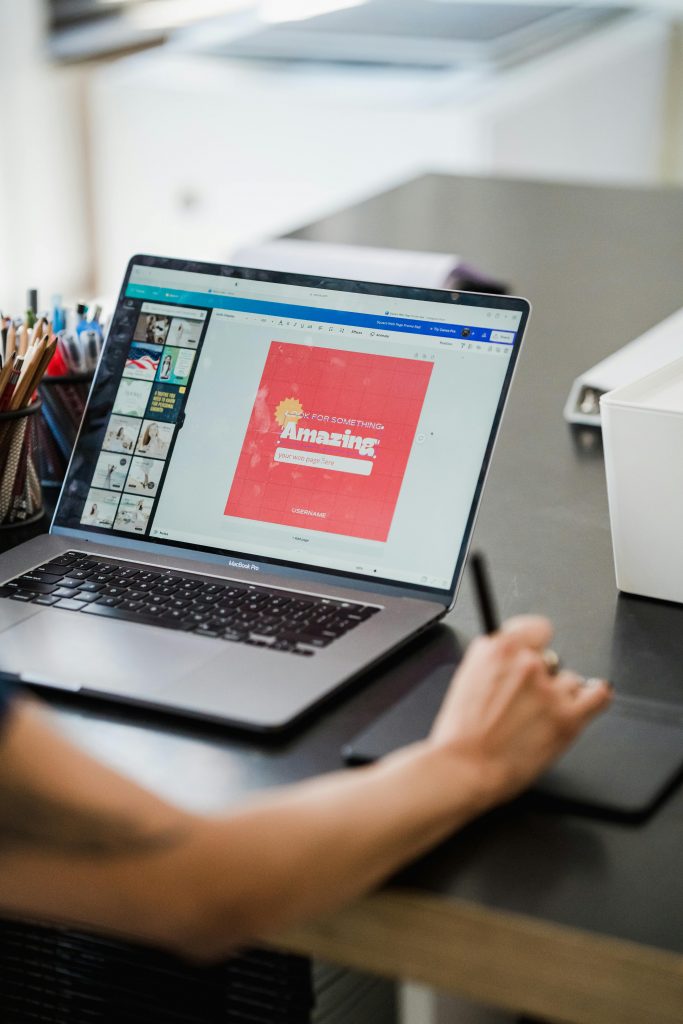
Then, before you start creating content from scratch, consider how much easier this becomes when you have professionally designed, branded templates that you can update with new text and images in minutes. This is one of the most underrated time-savers a new business can have — and one of the reasons social templates are included in a complete brand package rather than being an optional extra.
The difference between launching with a strong brand and launching without one
It’s worth being direct about what’s at stake here.
Businesses that launch with a coherent, professional brand spend less on marketing in the long run, because their marketing is more effective. Every social post, every email, every printed flyer is working from a consistent foundation — stacking up into something recognisable — rather than starting from zero each time.
They win pitches they might otherwise lose, because a professional brand signals that the business is established and trustworthy, even when it isn’t yet. They charge more, because perceived value correlates directly with how professional a business looks. And they attract better clients — the kind of clients who pay on time, refer others and don’t haggle on price.
Businesses that launch without a proper brand often find themselves rebuilding it twelve to eighteen months later, spending money twice. The website gets rebuilt. The logo gets redesigned. The social templates get remade. None of it was wasted exactly, but none of it built on itself the way it would have done with a solid foundation from the start.
Getting it right at the beginning isn’t about perfectionism. It’s about efficiency. A brand you can build on is worth considerably more than a brand you’ll outgrow.
What to do next
If you’re in the process of launching a business and want to get your brand right from the start — without locking yourself into contracts or ongoing agency retainers — the Uprize Digital Digital Brand Launch Kit gives you everything covered in this guide in a single, fixed-fee package.
Logo and brand identity, a bespoke website, SEO foundations, brand guidelines and social templates — delivered in 4 to 6 weeks, owned by you outright at the end.

